.png)


Professor Ileana Steccolini; Dr. André Lino; & Bernard Dom
Apr 14, 2023
Why is the toolkit relevant for your local authority?
Covid-19 is one of the most recent examples of abrupt shocks that are becoming routine for local governments. Additionally, local governments' operations (and finances) have been affected throughout the past decades - and are anticipated to be affected much more in the coming decades - by creeping strains like the rise in social care needs or the effects of climate change.
It is easy to observe that over the past few decades, local authorities have been facing greater demands to provide services to citizens, but at the same time, they have fewer resources available to support local public services. This is happening in a time when unprecedented shocks are shaping the overall context. Such sudden and slow burning crises makes financial resilience an increasingly important value for the operation of local governments. It refers to the local government's capability to sustain its functioning and promptly respond to crises, despite encountering financial difficulties.
Our research into both UK and international local authorities (Barbera et al., 2017, 2019, 2020) highlights that financial resilience refers to the ability not only to bounce back, but also bounce forward in the long term, and being able not only to buffer and adapt, but also to transform services, structures, systems and capacities to reflect continuous changes in the environment, and be robust and prepared for future crises, both sudden (such as the recent pandemic) or slow burning (such as climate change). As shown in figure 1, our research points out that central to financial resilience is the development of anticipatory and coping capacities by local authorities that, in combination with environmental conditions and perceived vulnerabilities, will affect their ability to anticipate, absorb, and react to shocks and changes affecting their finances and performance.
Figure 1. Dimensions of Financial Resilience

Source: Steccolini et al., (2018)
Anticipatory Capacities refers to the ability to identify and manage local government's vulnerabilities, to recognize (potential) shocks in an early stage, and to understand their impact on the operation of the government. It depends not only on tools/systems that are used to monitor the environment but also on civil servants awareness, perception, reasoning and judgment. Coping Capacities are resources and abilities that allow shocks to be faced and vulnerabilities to be managed. Both anticipatory capacities and coping capacities shape public services (non-financial) performance, and anticipatory capacities encourage bouncing forward strategies in responding to crisis.
While there is no one "one-size-fits-all" approach to resilience – since it depends on external and internal factors, such as on public sector organizations' latent capacities and on how they perceive their vulnerability in the face of a crisis - a comprhensive view on financial resilience highlights that local governments must pay attention to their existing anticipatory capacities as well as the coping capacities in place. Anticipatory capacities includes exchanging information with relevant stakeholders, such as higher levels of government and external service providers, monitoring changing regulations and needs, and promoting a culture of critical thinking within the organisation. In addition, local governments should have coping mechanisms in place, such as the ability to take swift action, fostering internal collaboration through inter-departmental dialogue, and collaborating with external stakeholders to develop timely solutions during a crisis. For further examples and details, please refer to Barbera et al. (2017, 2019, 2020).
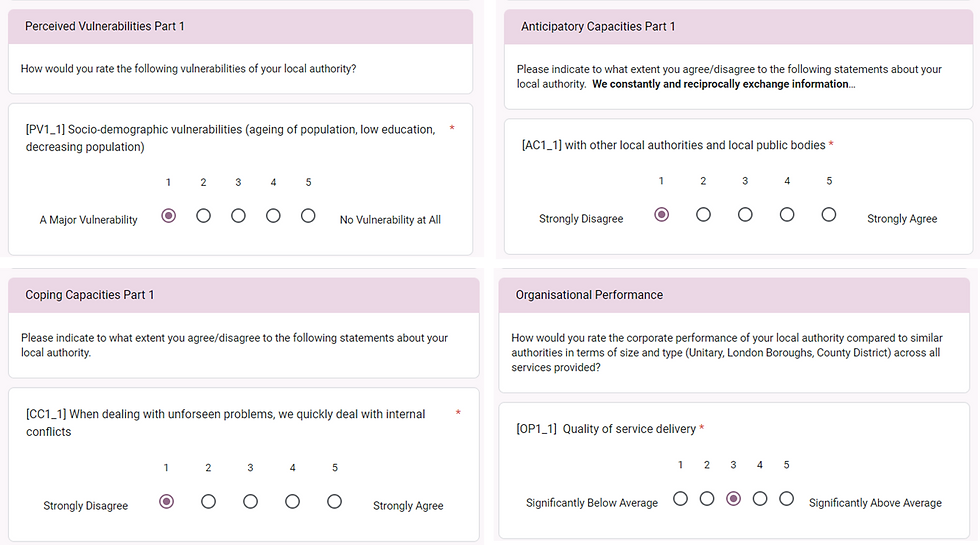
Our toolkit has a set of questions that are categorised into the main financial resilience dimensions identified in previous research (see Figure 2) to enable users to assess the current financial resilience level of their local authorities at the time of use. By reflecting on the capacities and organizational conditions that characterise local authorities in their daily operations, users of the toolkit can recognize the strengths and weaknesses that influence their organizations' preparedness for unexpected events and crises.
Figure 2. Questions related to each of the main financial resilience dimensions
After reflecting on the questions posed by the toolkit, users will access an external and internal reports that aims to provide a holistic picture of LA’s financial resilience and vulnerability level. The external report allows toolkit users to compare their LAs with peer authorities with (dis)similar characteristics. On the other hand, when used as an internal self-assessment tool, the toolkit gives local authority's managers early warning and awareness to sectors (departments) that may be exposed to specific strains and act to cope with such strains before they develop into an organisation-as-a-whole issue. The internal report enables local authorities to start a dialogue about available capacities and how they could be utilised efficiently to build and sustain their financial resilience.